



Why Donor Area Management Decides the Success of Your Hair Transplant: A Complete Patient Guide
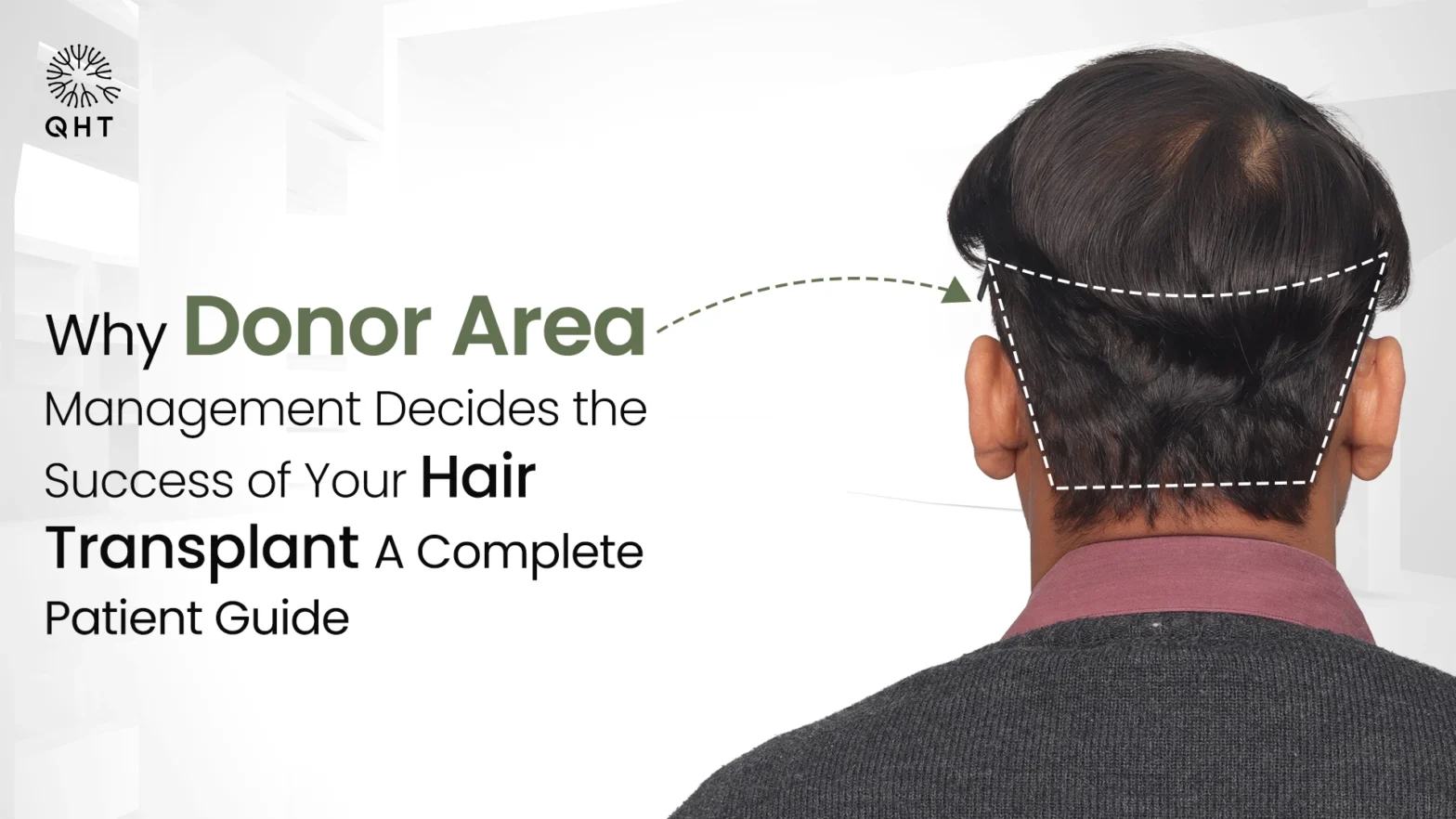
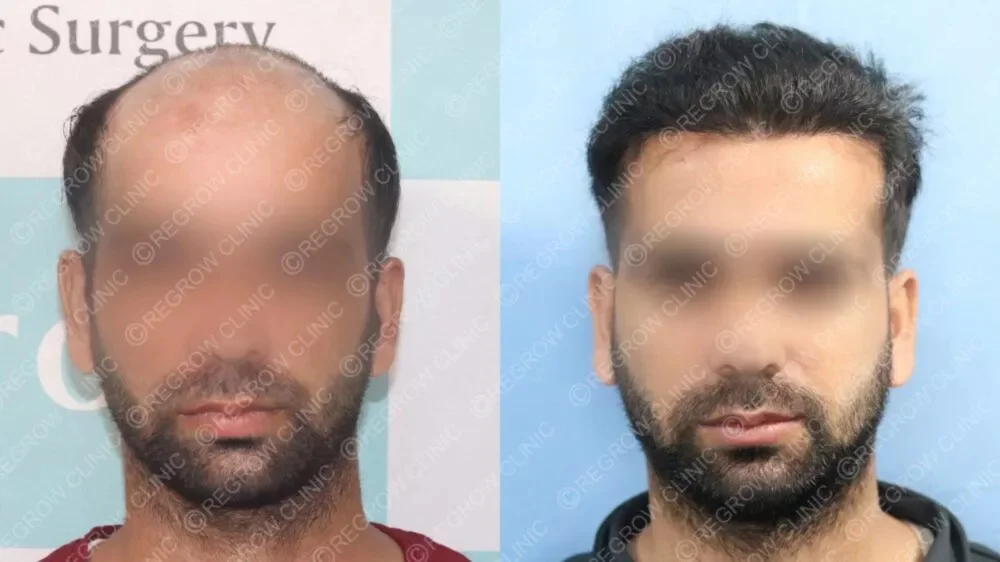
When considering a hair transplant, one typically focuses on the bald areas: how thick the front will be, how natural the hairline will look, and how soon the results will become apparent. The actual success begins at the back of the hairline, where most people do not pay close attention to the donor area. Every transplant is based on the donor hair. There is no clinic that will give guarantees of lasting or natural results unless the donor hair is well taken care of, healthy and safe. This is why it is one of the most significant aspects of planning and carrying out a successful hair restoration to manage the donor area.
This guide discusses the importance of your donor region as compared to the rest, the importance of not handling it incorrectly, as this may forever alter your appearance and how clinics such as QHT clinic employ scientific procedures to preserve all follicles. In case you desire a safe hair transplant in India, there is no greater thing you need than to first comprehend how to manage donors and then find a surgeon.
What is the Donor Area? Why Is It So Important?
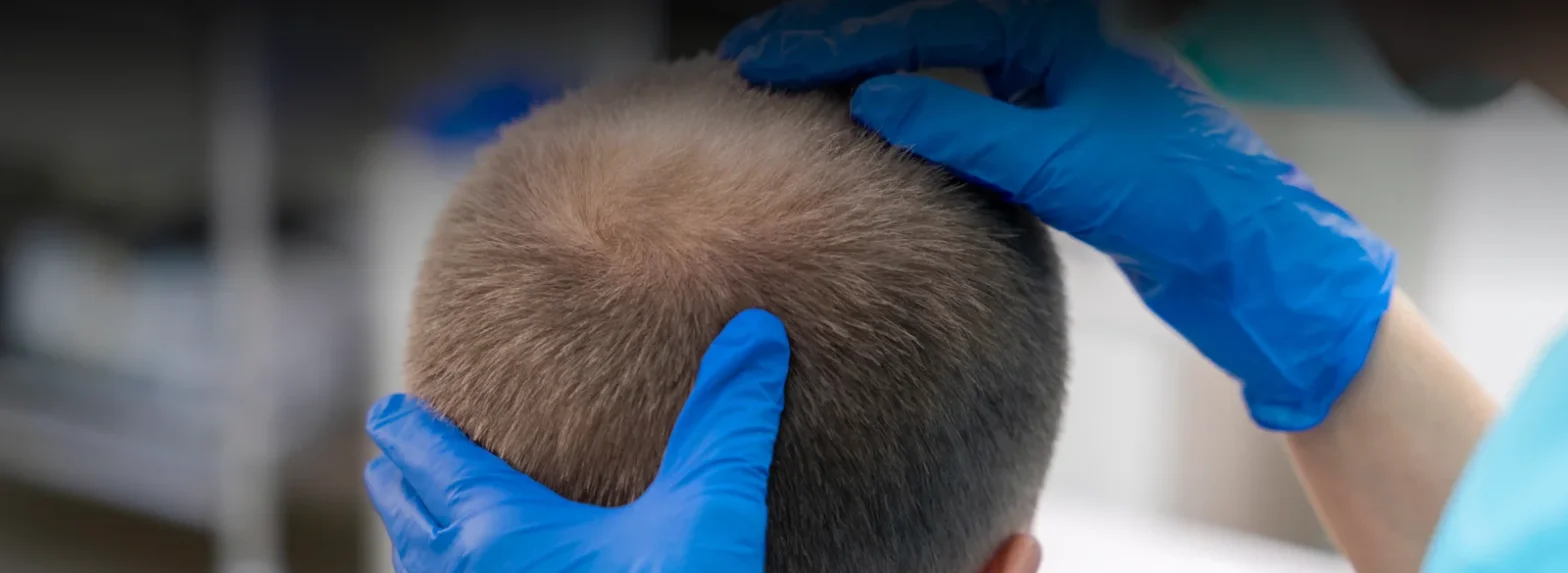
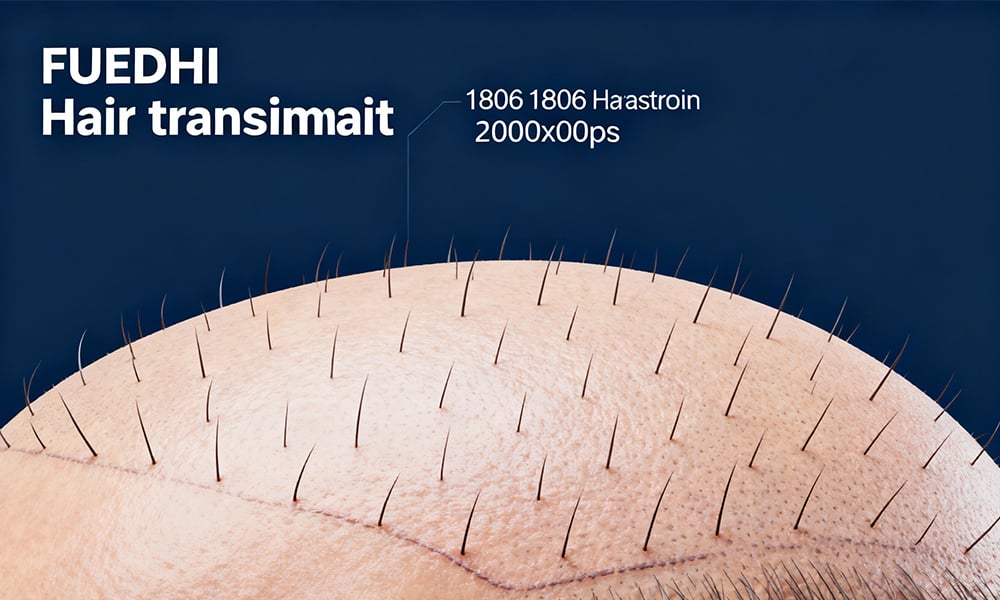
The donor area is the patch of hair on the back and sides of your head that is resistant to DHT (dihydrotestosterone) by nature. These are permanent hairs that continue growing even when you have advanced baldness. All the grafts obtained here are permanent.
- Donor hair is not unlimited. The number of grafts that you are likely to have is 4,000-6,000 grafts, depending on the density and the appearance of your hair.
- Once a follicle has been removed, it never regenerates. Excessive overuse may result in irreversible thinning–this is referred to as donor depletion.
- Donor hair of good quality provides fuller and thicker results. Better coverage is achieved by thick, dark, wavy grafts.
- This is why the naturalness and density of your transplant depend entirely on how good your donor hair is and how well it is cared for.
What Is Donor Area Management?
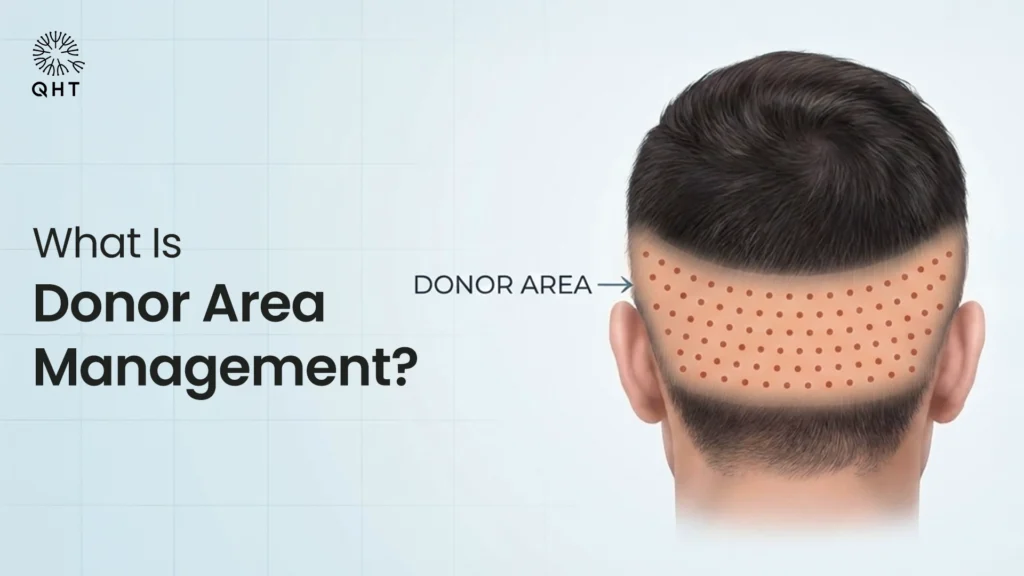
Donor area management is the science and planning of using the donor follicles in a careful manner, such that:
- You obtain the most desirable view.
- The region of the donor remains natural even after the grafts are removed.
- You still have sufficient grafts to lose your hair.
- No patchiness and scarring.
- No permanent injury to the donor area.
A good surgeon considers the donor zone and uses it as such a precious and limited resource, not as an inexhaustible store of hair. This concept is the philosophy of QHT Clinic. All grafts are charted, scrutinised and utilised with utmost care.
Why bad Donor Management ruined Hair transplant results
Most hair transplant failures happen not because of issues in the recipient area, but because the donor area was handled incorrectly. The following are the most prevalent issues that arise in case donor management is not considered:
1. Donor Depletion
Excessive grafting is done, creating too many grafts in a small locality, causing:
- Explicit scalp using the donor site.
- Unnatural patches
- Permanent thinning
Donor depletion is an important issue that should be prevented in contemporary transplant planning.
2. Moth‑Eaten Appearance
When grafts are randomly removed or not evenly distributed, the area of the donor will appear patchy.
3. Scarring, which is visible when the hair is short
An ineffective technique may result in dot scars or straight scars, which prevent a patient from shaving his head again.
4. The Bad Growth of Transplanted Areas
Unhealthy or miniaturised donor hair may also cause the area that undergoes transplantation to appear thin.
5. No Grafts to go around in Future Transplants
Lots of patients lose their hair as they grow older. In case the donor area has been overexploited prematurely, it has nothing to touch up.
These issues occur frequently, particularly in a low-cost, high-volume clinic where the inexperienced technicians do a graft without being aware of the long-term outcomes.
The Quality of Hair by a Donor: Why It Matters with Your Final Result?
The quality and the natural appearance of donor hair are essential in creating your final density and natural appearance. Good qualities include:
- Hair Calibre: larger hair shafts are increased in volume and coverage.
- Grafts Per Hair: The number of hairs per graft can be 1, 2, 3-4 or numerous. Multi-hair grafts produce a superior density, especially at the mid-scalp and crown.
- Hair Colour and Hair texture: Dark or curly hair has more visual density than thin, straight or light hair.
Special clinics, such as QHT Clinic, select the appropriate type of graft (1s, 2s, 3s) depending on the areas of the scalp, so as to achieve the appearance of the natural scalp and its balanced density.
The Significance of Prevention of Donor Depletion
The process of donor depletion prevention consists of ensuring that the donor area is not empty, unnatural, and appealing following the removal of several thousand grafts. These are laws to which a responsible surgeon abides:
- Never over‑harvest one area
- Keep at least 60-70 per cent of the hair left on to be naturally full.
- Spread extractions evenly
- Develop a scheme that resembles nature in spacing.
- Do not take too close grafts.
- Reserve grafts once the operation has been completed.
Many clinics aggressively try to show a higher graft count, and this often leaves patients with permanent damage. Donor imaging, density mapping and extraction planning provide these benefits at QHT Clinic to prevent such risks and retain donor health permanently.
Evaluating the Strength of Your Donor Area
A Pre-operative donor test should include:
- Density Measurement: The follicular units per cm 2 in a good donor area are 70-90.
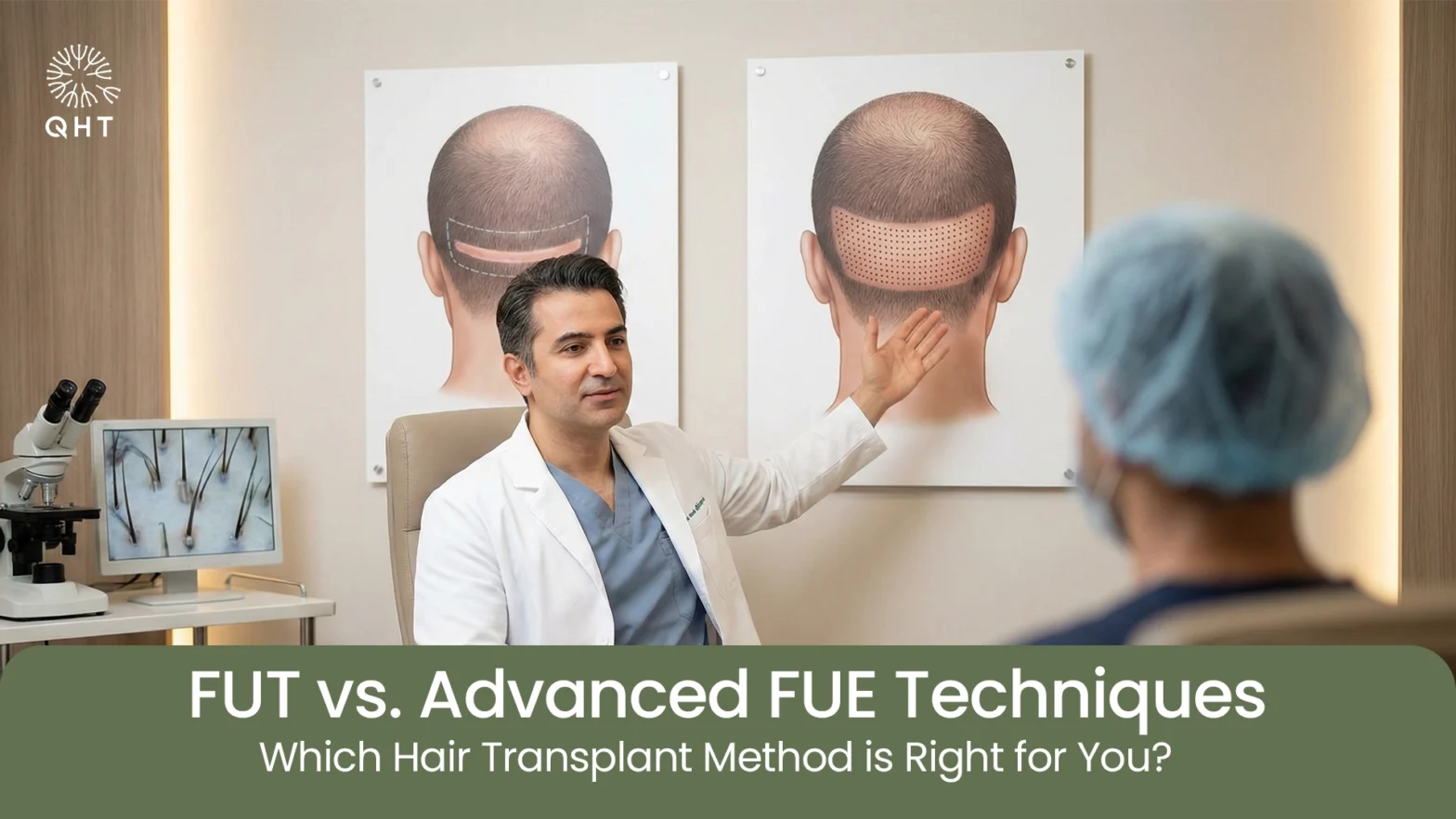
- Scalp Laxity Test: This is significant in the case of FUT strip surgeries.
- Miniaturisation Study: To determine that no current hair thinning exists.
- Graft Requirement Assessment: Only the responsible team will extract the necessary information.
It is a step-by-step examination that is a standard procedure at QHT Clinic as a measure to implement safe and predictable outcomes.
Scientific Donor Area Management Techniques: That Guarantee Better Results
The science of modern donor management is based on such protocols as:
- Safe Extraction Zones
It only extracts hair from areas with permanent growth, while unstable hair zones are avoided.
- Uniform Punch Distribution
Avoiding patchiness through extraction over the donor area that is even.
- Correct Punch Size and Angle
Unreliable angles of extraction may hurt the hair follicles and produce unnecessary scarring.
- Limiting Daily Extraction
Good clinics will restrict extracts to avoid damaging or transecting follicles.
- The grafts must be evaluated under a microscope to ensure their quality
Enhances success and placement.
- Recording Grafts to be used later
An effective clinic maintains donor history in order to avoid over-harvesting in future.
At the QHT Clinic, these scientific principles are applied in everyday practice, which guarantees the preservation of the donor in the long term and always natural outcomes.
- The Importance of Donor Management in Young Patients
Hair loss is progressive in patients who are in their 20s and early 30s. This means:
- Baldness will come even more in the future.
- It might require additional transplants.
- The donor zone should be handled with a lot of care.
- One of the major causes of donor depletion at a later age is aggressive extraction in young patients.
A well-trained surgeon will never fail to plan:
- A low-dose preliminary transplant.
- A long-term strategy
- Saving of donors to fulfil future needs.
This is why many younger patients prefer the detailed planning methods used at QHT Clinic, where every decision is based on long-term safety.
How the Management of the Donor Area Determines the Success in the Long Term
A good transplant not only appears good in the first year but also should appear good for decades.
Donor management has an impact on long-term success:
- It guarantees long-lasting, intensive results.
- Healthy grafts that have good survival chances are used.
- Makes the Donor Region appear natural.
- When you shave your hair later on, the place where it was donated should not appear patchy.
- Leaves future transplantation choices.
- Avoids Scarring and Lumpy texture: The technique is good, giving little visible scarring.
- Maximises Lifetime Graft Value: You have a small resource in the form of your donor area- it is important to utilise it wisely.
The result is that the more your donor is managed, the more natural, thick and long-lasting you will be.
Conclusion
Hair transplant: It is not only that bald patches are to be filled, but a medical and artistic operation that demands:
- Precision
- Knowledge
- Planning
- Ethical extraction
- Long-term vision
The most valuable asset to you is the donor area. Once it is destroyed, overharvested or poorly managed, the error is irreversible. This is because a good transplant, where you have the donor area well done, good quality of donor hair and good donor depletion, will see to it that your success is genuinely natural, thick and long-lasting. When you are in search of a safe hair transplant in India, make sure that you fall into clinics that will secure your future, and not only your present.
Book a Consultation Today
Latest Videos
-

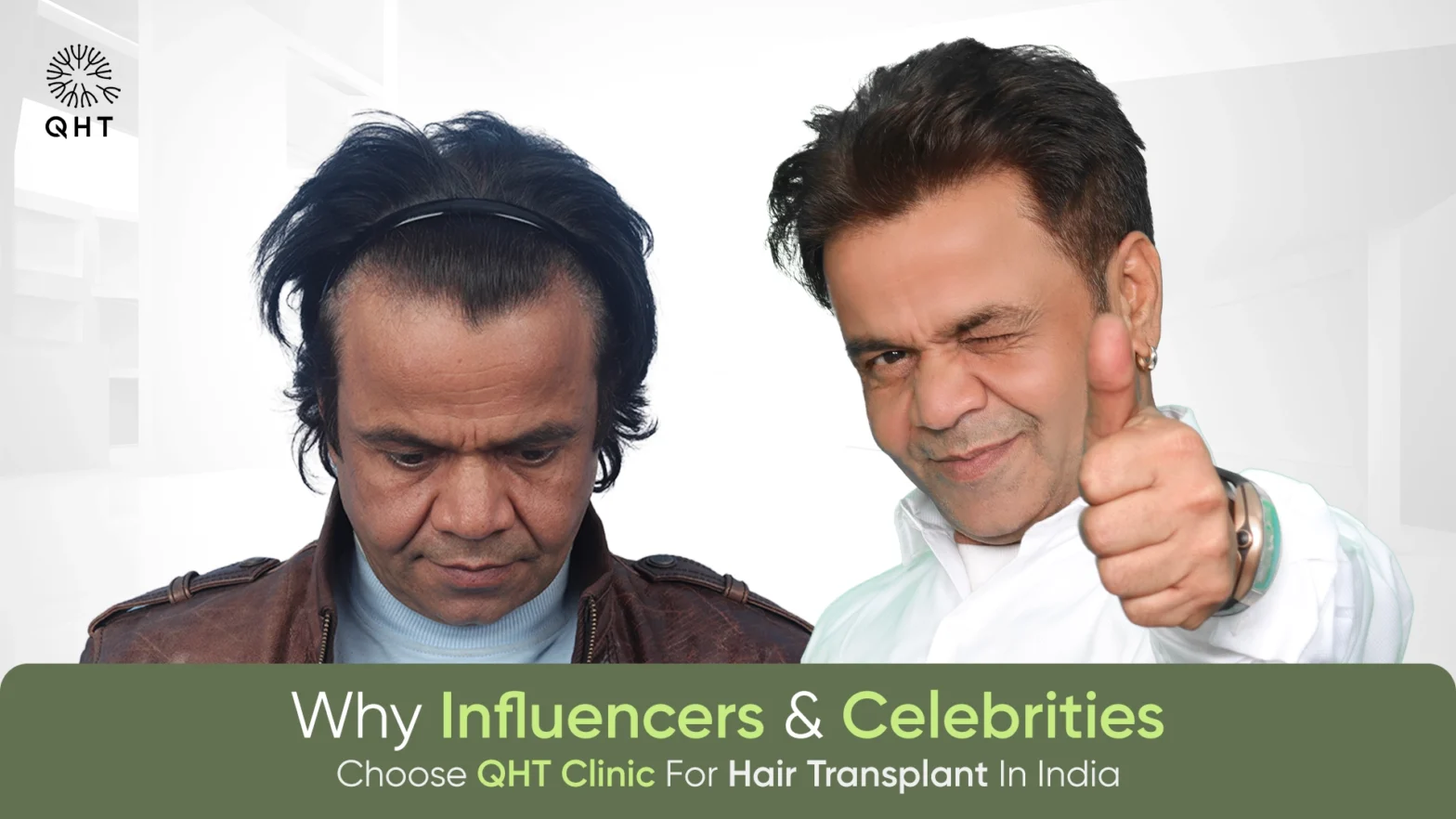
Rajpal Yadav | Bollywood Actor Hair Transplant Journey at QHT Regrow Clinic Haridwar
Click to Watch
-

FUE Hair Transplant Results | DAYA's FUE Hair Transplant Results
Click to Watch
-

Best Hair Transplant Result 2021 || NW Grade VI A || 3,422 Grafts
Click to Watch
-

Best Hair Transplant Result 2022 | Grade 4
Click to Watch
-

YouTuber Mehtab Saifi Hair Transplant
Click to Watch
-
ACP Pradyuman Hair Transplant - Actor's Hair Transplant
Click to Watch